Tuesday, March 28, 2017

The Shape of Time


According to George Kubler, biographies possess multiple limitations or restrictions.  Biographies and catalogues alike only have the ability to give a general idea or outlook on the nature of artistic traditions.  They cannot easily depict the 'historical questions in artists' lives', which is the question of how they can connect what has come before and what will come after their artistic periods.

Individual Entrances

While the life of an artist is typically a sector of a biographical series, it is almost fruitless to make it the central piece of the series.  Doing this doesn't allow for a rounded explanation of experiences, occurrences, and general happenings that took place during the lifespan of the appraised artist.  Instead, the situation should be looked at and addressed as if an artist's lifework has the ability to precede as much as it does to surpass him or her.  The entrance of the artist, as said by Kubler is what differentiates the artist from that instead of a copyist.  This entrance enables the start of a tradition that only the artist is responsible for.  While there are "good" or "bad" entrances, this solely depends on the placement of the connection between the artist's personality or disposition (temperament) and a "favorable position" into a sequence.

Talent and Genius

Here, Kubler has pointed out that while talent is regarded as an aspect of predisposition belonging to individuals, it cannot be categorized in degrees, but rather different kinds.  Further on, it is stated that the term "genius" is continuously used incorrectly.  While most people think of it to be a predisposition, Kubler believes it has to do with a "fortuitous keying together of disposition and situation into an exceptionally efficient entity."  Personally, I read this as the people we deem "geniuses" have been able to effectively take advantage of every opportunity given to them at the right time to generate exceptionally beneficial outcomes throughout their lives.

Biological and Physical Metaphors

Style is introduced as a metaphoric plant; its first section of leaves start out small, while the midsection is fully formed, and finally the last leaves are small, yet prominently defined by their shape.  
While "material culture" would have been a better phrasing to Kubler than "history of things", both emanate from different works crafted and reworked by human hands with the help of guided ideas developed in temporal sequence.

The Invisible Chain

Among artists, prior events that occur before them determine the previously mentioned sequences.  Additionally, these prior events paired with future opportunities determine the position of every work of art.

Solitary and Gregarious Artists

Commonly, the appreciation of works of art and what actual work has been put behind them is only revealed after the artist's death.  Kubler believes that all important artists belong to this "lonely class".  Yet occasionally, the artist will be seen as a rebel.  But today the artist is neither a rebel nor an entertainer.  Being rebellious requires external effort away from the actual work than the artist wants to make.
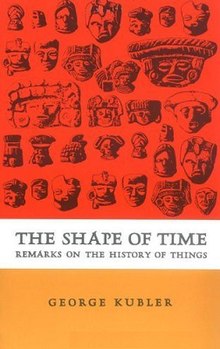
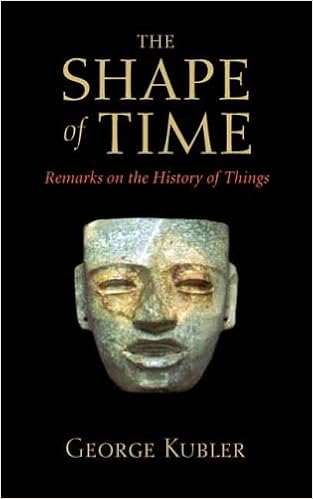

Image result for the shape of time kubler     Image result for the shape of time kubler


Tuesday, March 14, 2017

The Art of Data Visualization


Although personally for me, the actual definition of data visualization was not as clear as it could have been in this video, I did pull some important aspects from the clip.  For instance, data visualization is apparently a "history of science" due to the fact that analyzing and depicting difficult or incomprehensive versions of natural sciences or similar conditions as pictures has been going on since the time of the caveman.  Additionally, data visualization follows the same linear process of a "few basic principles" that an ordinary individual's mind would follow when looking at or constructing a work of art:

1. the artist's perception
2. the viewer's (reader's) perception; knowing that they will be different aside from the original artist's
3. the raw truth given from the work of art (data)

Simply put, data visualization is an effective method of gathering difficult or even conflicting information, and making it as straightforward as possible through pictures, graphs, and visuals alike.

Sunday, February 19, 2017

Monday, February 6, 2017

"Uncertain Passages" Loyola Maryland Art Gallery Exhibit by Jay Gould

Last Thursday, I attended a gallery opening at the Julio Fine Arts Gallery for a local artist named Jay Gould.  His work focuses on the integration of scientific topics into projects of photography.  What was interesting about this artist was that he liked to expand upon the manipulation aspects of photography.  Most, if not all of his pieces focused on the after effects one can do with a photograph once it's taken.  Additionally, it was interesting to know that he had a fascination for physics and topics surrounding phenomena that can't be explained through the extensive collision of math and science.


Mirrors are Leaks-Jay Gould

As previously mentioned, a vast amount of Gould's work demonstrated his talents through what he could do with the picture after it had already been taken.  I was drawn to the pieces where you could tell that something was missing, it was actually quite obvious, but they also had the ability to leave you feeling uneasy or unsure about why these obvious pieces were missing.


Slipping-Jay Gould
Here are some additional pieces that caught my eye:

Aggregate-Jay Gould
Tidal Passage-Jay Gould

John Berger: Ways of Seeing, Episode 1


The impact from watching this video was quite monumental.  Although everything said made complete sense, I had never thought about the reproduction of original art in the way that it was discussed.

John Berger's opening statement about how the process of seeing paintings or seeing anything at all is less spontaneous and natural than we believe was interesting.  It made me think about how I usually see things, and normally, it's a very natural process for me; most of the time it's second nature and I don't think too deeply into it.  But the emphasis on how a large part of seeing is dependent upon habit and convention, along with the explanation of how perspective is key, made me think that some things (like seeing) we definitely take for granted.

The second installment about how the invention of the camera has changed how we see things and exactly what we see..well, that's common sense.  I believe the camera was invented not only to capture images we see fleetingly, or are unable to investigate in depth, but also to be able to manipulate those images either to our liking or not.  It makes sense that the camera has now added a new dimension between the viewer and the image procured.

Although John Berger attempted to point out the good and bad aspects of the creation of the camera in the face of ancient paintings and drawings, I honestly could only stick with the "bad" aspects.  These being that the originality of a painting is almost completely lost when a camera attempts to recreate and capture its essence.  But, this can also translate to the fact that meanings that arise from original paintings remain with the authentic image, and cannot be made mobile like the camera has done to the image itself.

Additionally, the final segment on surroundings and how they impact an individual's opinion on a painting was especially intriguing.  Surroundings can be anything that can alter one's perspective on a given image once they are placed, before, during, or even after you've viewed an image.  For instance, with music, if a certain tune or song is played simultaneously while viewing an image, it allows for different interpretations, feelings, and perspectives attached to that image at that given moment.  It's similar with what a person experiences or sees before or after the focal image is placed in front of them.  The example used in the show was the image Van Gogh painted before he committed suicide.  More often than not, the viewer would not know this information beforehand, and the only information shared about the image was its description.  People tend to look at things differently once they are told different types of details about what they are looking at.

In summary, it was interesting to learn that the invention of the camera not only made images mobile, but then created different meanings for the image captured other than its original one(s).  In other words, the reproduction of art makes the meaning of works ambiguous.